
AI Event Activations Trends for Brands
AI event activations trends for brands are shifting towards refined, design-led experiences that create shareable content and lasting impact.
The most effective event spaces no longer compete on spectacle alone. They win on participation, polish and what guests leave with – not just in hand, but on camera roll, socials and memory. That is why AI event activations trends for brands are moving in a clear direction: away from novelty for novelty’s sake, and towards beautifully considered experiences that feel interactive, premium and unmistakably current.
For brand teams, agencies and event planners, the question is no longer whether AI belongs at live events. It is where it belongs, how visible it should be, and whether it adds genuine value to the guest journey. The best activations do not feel like tech demonstrations. They feel like part of the event’s creative language.
Why AI event activations trends for brands are changing
A few years ago, AI at events often appeared as a talking point in search of a format. It drew attention, certainly, but attention alone is not the brief for most premium events. Brands want dwell time, elegant content capture, social sharing and a guest experience that aligns with the rest of the production.
That shift matters. A luxury drinks launch, a fashion-led brand dinner or a prestige staff event cannot afford an activation that feels bolted on. The installation must sit comfortably within the wider visual identity, from set design and florals to lighting and printed materials. AI is becoming more valuable because it can now support that standard rather than interrupt it.
There is also a practical reason for the change. Guests have seen a lot. They are less impressed by generic digital gimmicks and more responsive to experiences that are personalised, beautifully designed and instantly rewarding. If an activation creates a bespoke portrait, a collaborative artwork or a gallery-worthy branded keepsake, it earns its place.
The strongest trend is personalised content with a premium finish
The most commercially useful AI activations are those that create something bespoke in real time. That could be an illustrated portrait, an AI-led transformation of a guest image, or a collaborative visual output that evolves over the course of the evening.
What separates a strong installation from a forgettable one is the finish. Guests are far more likely to engage when the end result looks considered enough to post, print or keep. For brands, this means the content itself becomes part of the event’s afterlife. A guest who leaves with a beautifully rendered AI sketch or appears in a refined branded mosaic is carrying the event beyond the venue.
This is why design-led formats are outperforming louder, less curated concepts. The output must feel elevated. The branding must be integrated rather than stamped on at the end. And the activation should photograph as well as the content it creates.
AI illustration is replacing one-size-fits-all photo moments
Static photo moments still have their place, but the appetite has shifted towards transformation. Guests want to see themselves reimagined, stylised or incorporated into something larger. AI sketch experiences and AI-generated art walls answer that demand because they turn a simple pose into a tailored result.
For brands, this opens a more expressive route than traditional event photography alone. A beauty brand may favour refined portrait outputs with a fashion editorial feel. A retail launch may use AI visuals that draw from the campaign world. A corporate celebration may prefer a more polished, universally flattering approach that invites broad participation.
The trade-off is that style matters enormously. If the visual treatment feels gimmicky or inconsistent with the event, the activation can date quickly. The strongest executions start with the brand world and build the AI output around it.
Guests want installations, not equipment
One of the most important AI event activations trends for brands is presentational. Audiences respond better when the experience is framed as an installation rather than a piece of tech placed in a corner.
That means the footprint, styling and guest flow all matter. The activation should feel spatially considered, with an obvious invitation to take part and a clear reveal moment. Premium events benefit from activations that hold their own visually even before anyone uses them.
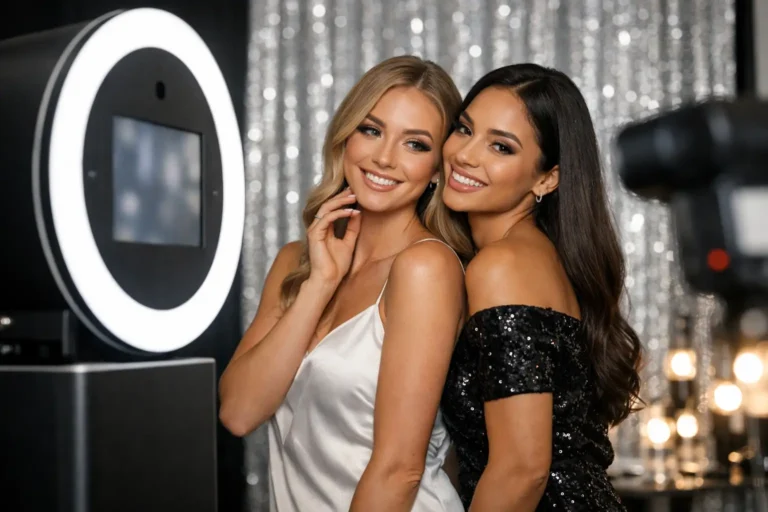
This is especially true at high-profile corporate events, where every detail contributes to brand perception. An oak-crafted photo booth, a clean monochrome portrait station, or an AI graffiti wall with a striking scenic build says far more than exposed hardware ever could. The physical presence sets expectations for the quality of the experience.
Collaborative visuals are becoming more valuable than one-off moments
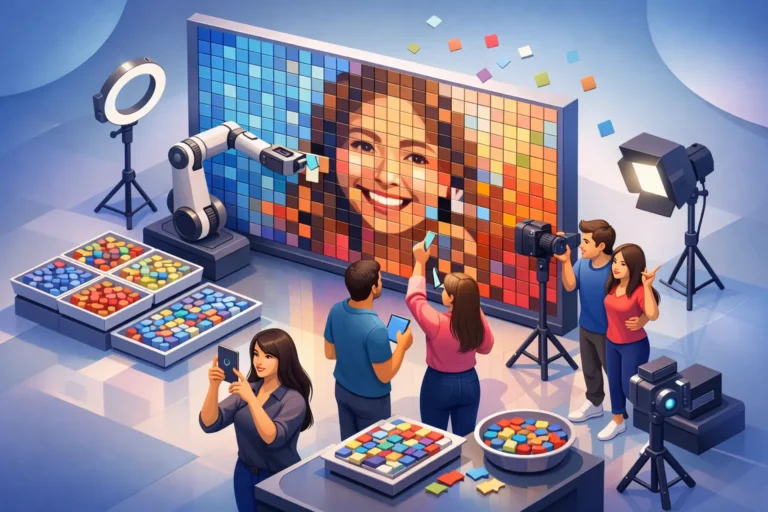
Individual content still performs, but brands are increasingly interested in activations that build towards a bigger visual story. Mosaic walls are a strong example because they combine personal participation with a collective reveal. Each guest contributes a tile, but the full installation becomes a statement piece for the event.
This works particularly well for internal brand events, awards evenings and public-facing activations where organisers want a sense of momentum across the day. Early guests see the piece beginning to form. Later guests arrive to a visibly evolving artwork. By the close of the event, the installation has become part entertainment, part branded centrepiece.
There is also a subtle strategic advantage here. Collaborative activations encourage repeat attention. Guests come back to check progress, photograph updates and point the piece out to others. That return engagement is often more useful than a single interaction.
AI graffiti and live creation add theatre
Another clear direction is live creation. Audiences enjoy watching content happen in front of them, especially when the process feels fast, polished and visually bold. AI graffiti walls and live generative art installations succeed because they add performance to participation.
This suits brands that want energy and visibility, but the approach needs editing. Not every event benefits from a high-intensity visual treatment. For a premium private event or a more formal corporate setting, the artwork should still feel refined and aligned with the room. The lesson is not that louder is better. It is that visible creation is compelling when the creative direction is disciplined.
Brand alignment matters more than the technology itself
The most successful AI activations do not begin with a tool. They begin with a question: what should guests feel, share and remember?
For some brands, the right answer is elegant portraiture with beautifully lit black-and-white imagery. For others, it is a playful AI-generated artwork that sparks conversation. The technology only earns its place when it supports the desired atmosphere and output.
This is where many event concepts either feel elevated or fall flat. If the activation is visually disconnected from the wider production, guests notice. If the guest journey is unclear, queues build and engagement drops. If the output does not feel worth keeping, the interaction ends the moment it is printed or sent.
A thoughtful brief usually covers four things: the visual style, the level of branding, the guest throughput and the intended after-event use of the content. Once those are clear, the choice of activation becomes much more obvious.
What brands should look for in 2026 and beyond
The next phase of AI event activations trends for brands will favour restraint, not excess. The market is maturing, and with that comes higher expectations. Guests will continue to respond to personalisation, but only when it is delivered with taste.
That means polished imagery over novelty filters. Curated installations over cluttered tech zones. Shareable outputs over abstract promises of innovation. It also means reliability will become a bigger differentiator. At a prestigious event, the standard is not simply that an activation looks good when staged. It must perform confidently under pressure, fit naturally into the run of show and leave organisers free to host rather than troubleshoot.
For planners and marketers, the best approach is selective. You do not need AI in every corner of the event. One beautifully executed activation will usually create more impact than several competing touchpoints. If it complements the brand, photographs impeccably and gives guests something genuinely desirable to take away, it has done its job.
At MooMuu Experiential, that philosophy sits at the heart of every design-led installation – technology used not as noise, but as a refined way to create unforgettable moments. For brands, that is the real opportunity ahead: choosing AI experiences that feel less like a trend and more like a signature part of the event.
The smartest activations will always be the ones guests remember as part of the atmosphere, not apart from it.