
How Much Space Does a Photo Booth Need?
How much space does a photo booth need? Plan the right footprint, ceiling height and guest flow for a polished, design-led event setup.
If you are planning a wedding or branded event, one practical question tends to surface early – how much space does a photo booth need? It matters more than most people expect. A beautifully designed booth can become a standout feature of the room, but only when it has enough space to breathe, photograph guests properly, and sit naturally within the wider event layout.
The short answer is that most premium photo booth installations need more than the footprint of the booth itself. You are not only making room for the unit. You are creating space for the guest experience: people stepping in, gathering around, waiting comfortably, and moving through the area without disrupting the bar, dance floor or dining setup.
How much space does a photo booth need in practice?
For most events, a sensible starting point is around 3m x 3m. That usually gives enough room for the booth, a backdrop if required, and comfortable standing space for guests. If you are planning a more design-led installation, or you want larger group shots, a 4m x 3m area often feels more polished and relaxed.
This is why space planning should never be reduced to a single measurement on a floorplan. A booth may physically fit into a tighter corner, but that does not mean it will perform well there. Luxury events rely on flow, proportion and presentation. If guests feel squeezed, if the queue cuts across a walkway, or if the backdrop sits hard against a fire exit, the finish immediately feels compromised.
For high-end weddings and corporate events, the ideal setup is one that feels intentional rather than tucked in wherever there happened to be room left.
The footprint is only part of the story
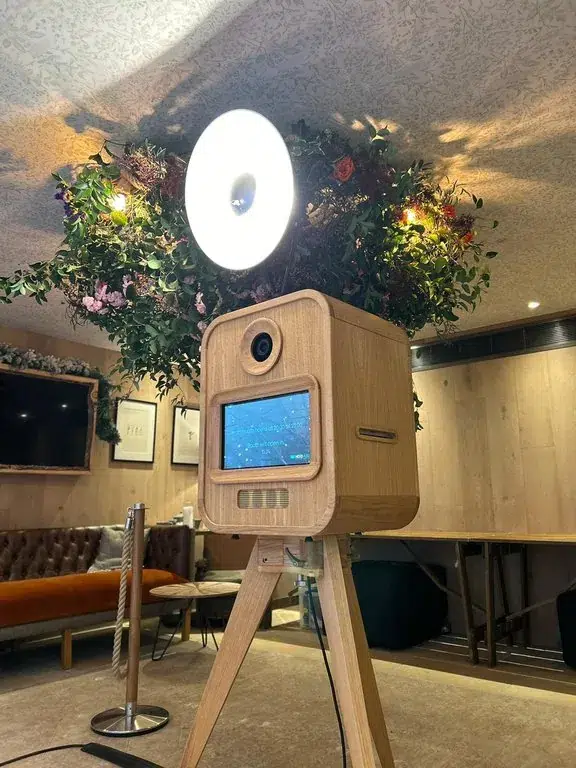
A photo booth installation usually includes several layers. There is the booth itself, which may be compact or more statement-led depending on the style chosen. Then there is the operating zone in front of it, where guests stand to be photographed. Add a backdrop, prop table or styling elements, and the usable area grows quickly.
The surrounding guest space matters just as much. At a lively reception, people rarely arrive one at a time. Couples step in together, friends gather on the edge, and a small audience often forms around the booth. That is part of the atmosphere. It also means the space has to support energy and movement without looking crowded.
For a refined event, the most successful placements allow for three things at once: guests using the booth, others waiting nearby, and the rest of the room continuing to function normally.
Ceiling height and overhead clearance
Floor space gets most of the attention, but ceiling height can be just as important. Certain venues, particularly marquee structures, heritage buildings and converted barns, may have beams, chandeliers or lower sections that limit where equipment can be placed.
As a guide, you want enough overhead clearance for lighting and for the setup to feel visually balanced. A cramped ceiling can make the area feel compressed, and that affects the final look of the photographs as much as the guest experience. If the booth includes taller framing, signage or lighting, planning this in advance avoids awkward last-minute repositioning.
Access routes matter too
Even a perfectly sized booth area can become problematic if access is tight. Staircases, narrow corridors, gravel paths and restrictive loading points all influence where an installation can realistically go. From a guest perspective, accessibility also matters. The route to the booth should feel simple and inviting, not hidden away in an annex that loses the energy of the event.
The right space depends on the booth style
Not every photo booth asks the same thing of a venue. A sleek digital setup may work elegantly in a more compact footprint, while a retro-style booth with stronger visual presence may benefit from extra surrounding room so it reads as a feature rather than furniture.
Open-style booths generally need more clear floor area in front because they are designed for group interaction and wider framing. Enclosed or more self-contained concepts can sit within a smaller footprint, but they still need breathing room around them for queuing and circulation.
Then there are statement installations that move beyond a traditional booth format. Glam experiences, mosaic concepts and AI-led activations often deserve more prominence because guests engage with them differently. They attract attention, encourage repeat visits and create a stronger visual anchor within the room. In those cases, allocating extra space is not wasteful. It is part of giving the installation the presence it needs.
Where a photo booth should sit in the room
Placement shapes how often the booth gets used. Even the most exquisite setup will underperform if it is hidden in the wrong corner. The ideal position is visible, easy to reach and naturally integrated into the event journey.
At weddings, that often means placing the booth near the evening reception space rather than in a separate room. Close enough to the dance floor to feel connected, but not so close that guests are photographed against a backdrop of passing traffic and speaker stacks. Near the bar can work well, as long as queues do not collide.
At corporate events, the best location depends on the goal. If the installation is intended to drive engagement, collect branded content or act as a talking point, it should sit where footfall is strong. If the purpose is to offer a more curated VIP experience, a slightly more defined zone can feel appropriate, provided it still feels connected to the main event.
Space for guest flow, not just guest photos
This is where many floorplans fall short. They account for the booth, but not for human behaviour. Guests drift, gather, watch, laugh, retake photos and pause to collect prints or admire the results. That social layer is exactly what makes a premium installation feel lively, but it does need room.
A good rule is to think in terms of an experience zone rather than a booth footprint. That usually includes the installation itself, the photography area, side clearance, and a small waiting pocket around it. Once you think this way, the required space becomes much easier to visualise.
Venue type changes the answer
Country houses, luxury barns, hotels and marquees all present different spacing realities. A grand hotel ballroom may have generous dimensions but tighter rules around where equipment can be positioned. A barn may offer character and atmosphere, but with structural posts, uneven walls or low-hanging features that affect setup. Marquees can be wonderfully flexible, though entrances, flooring and power routes need careful coordination.
This is why the best answer to how much space does a photo booth need is often: enough to suit the room, the guest count and the style of installation. Two events with the same number of guests may need entirely different layouts because the venue architecture changes how people move.
For larger guest lists, the booth area should be scaled with comfort in mind. Not because every guest will use it at once, but because higher attendance creates more momentum around any interactive feature that looks good and photographs beautifully.
Why giving it extra room pays off
When a photo booth has the right amount of space, everything improves. The queue feels elegant rather than awkward. Group shots are easier. The backdrop reads properly in photographs. Guests engage more naturally because they are not worried about knocking into chairs or blocking a walkway.
There is also a visual benefit. Premium events are built on composition. Floral design, lighting, tablescape, staging – each element is given space so it can be appreciated. A photo booth should be treated the same way. If it has enough room, it feels like part of the event design rather than an afterthought.
For clients who care deeply about aesthetics, that distinction matters.
Planning the space with your supplier
The smoothest events are usually the ones where the booth is considered early, not added onto the floorplan at the final stage. Sharing venue plans, ceiling details and intended guest numbers allows your supplier to recommend the right installation and the right positioning.
A design-led partner will look beyond whether the booth can physically fit. They will consider sightlines, guest flow, background distractions and how the setup will appear in the room. That is especially valuable at luxury weddings and prestigious corporate events, where every element is expected to feel considered.
At MooMuu Experiential, this is part of the wider approach – creating installations that look exceptional in situ, not just in isolation.
If you are deciding how much room to allocate, give the booth slightly more space than the minimum and treat it as a feature. The best event moments rarely happen in the tightest corner of the room.