
Conference Engagement Wall Case Study Results
A conference engagement wall case study showing how a design-led interactive installation lifted footfall, dwell time and branded content.
By 10.15am, the coffee queue had already formed, the keynote room was filling, and the brand team had a familiar problem – plenty of attendees in the building, but too few meaningful interactions on the exhibition floor. This conference engagement wall case study looks at how one interactive installation changed that dynamic, turning passive footfall into visible participation and branded content worth keeping.
For corporate events, engagement is rarely a volume game alone. A busy venue can still feel flat if guests drift past stands, collect a tote bag, and move on. The stronger brief is usually more nuanced: create a focal point, encourage genuine dwell time, gather high-quality content, and do it in a way that feels aligned with a polished brand environment. That is exactly where an engagement wall earns its place.
What made this conference engagement wall case study different
The event in question was a leadership and innovation conference for a national brand hosting clients, partners, and internal stakeholders. The audience was mixed – senior decision-makers, marketing teams, regional leads, and invited guests – so the activation needed broad appeal without losing its premium feel. Novelty on its own would not have been enough. The installation had to look considered, operate flawlessly, and support the wider event narrative rather than compete with it.
The brief centred on three outcomes. First, increase interaction in a networking zone that had previously underperformed. Second, create a visual moment that evolved throughout the day rather than peaking for ten minutes and fading. Third, produce content the brand could use after the conference, both internally and across social channels.
A live engagement wall was chosen because it solved all three at once. Instead of asking attendees to consume content passively, it invited them to contribute to it. That shift matters. When guests can see their action become part of a larger visual piece in real time, the experience feels more personal and more memorable.
The event challenge behind the installation
Like many conferences held in refined hotel and venue settings, this one had strong production values but an exhibition layout that needed more rhythm. The main stage carried the authority. The breakout rooms had practical purpose. The networking space, however, needed a stronger centre of gravity.
That is often the hidden challenge with conferences. Guests are willing to engage, but only if the activation feels worth the pause. If it looks too promotional, they pass by. If it appears overly complicated, they hesitate. If it jars with the event aesthetic, it can cheapen the room rather than elevate it.
The organisers were also conscious of audience psychology. At conferences, people take cues from each other. The first moments matter. Once a few guests engage and the installation begins to build visually, momentum grows. Before that point, the barrier to participation is higher. So the design and guest journey had to feel instantly legible from a distance.
How the engagement wall was designed for conference flow
The solution was a design-led wall installation positioned between the main networking area and refreshment point – a location chosen very deliberately. Rather than forcing traffic towards the experience, the installation sat within an existing movement pattern. Guests encountered it naturally on the way to coffee, conversation, and breakout sessions.
Visually, the wall was tailored to the conference identity, with branding integrated in a restrained, editorial way. That distinction is important. At premium events, branding works hardest when it feels embedded rather than overapplied. The wall looked like part of the event design language, not a bolt-on attraction.
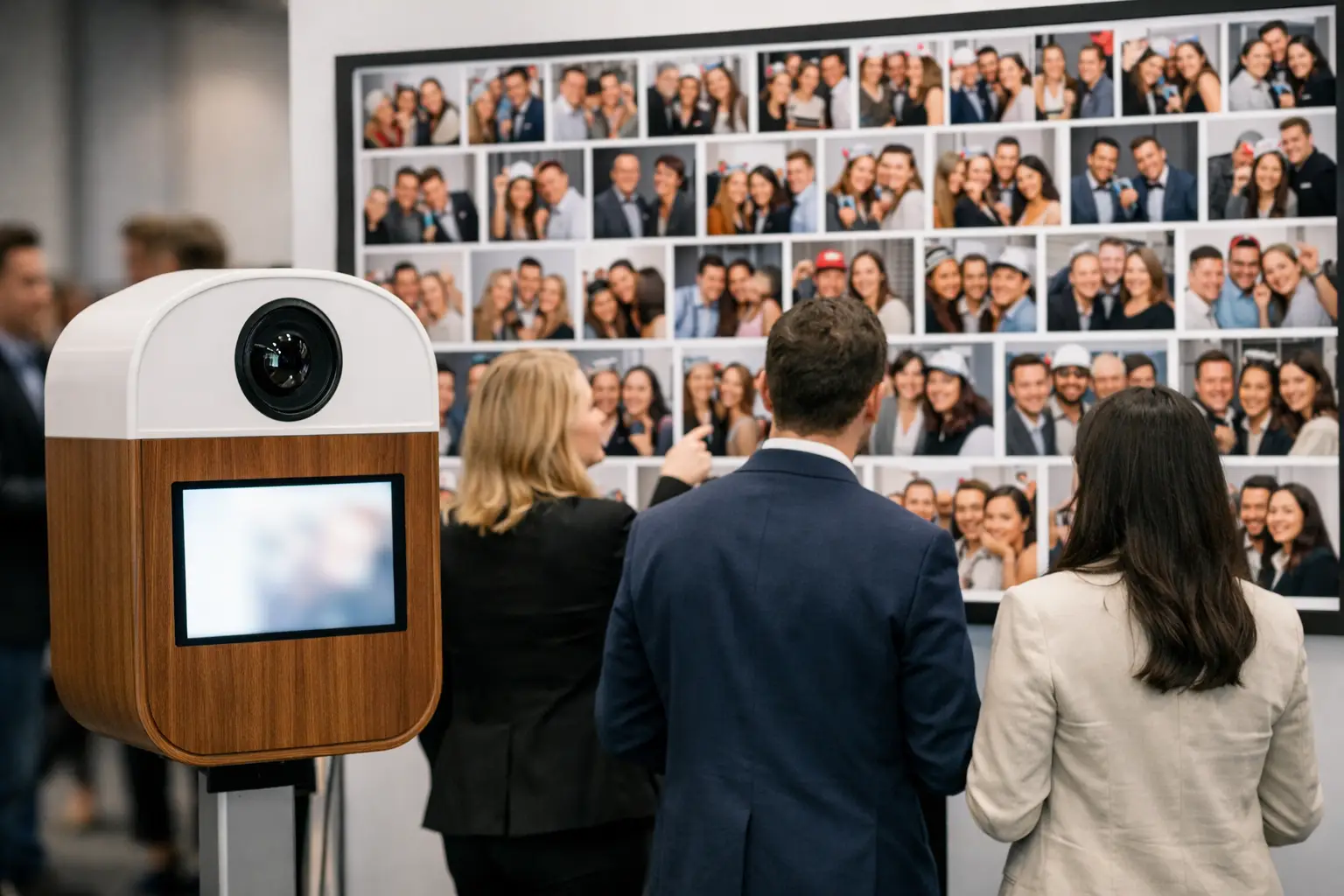
The interaction itself was simple. Attendees had their photograph captured and converted into a tile within a larger mosaic-style visual reveal. As more guests took part, the wall transformed from a series of individual moments into one cohesive branded image. That progressive reveal gave people a reason to return later in the day, which extended dwell time far beyond the initial interaction.
A host team supported the experience with light-touch guidance. Not sales patter, not forced enthusiasm – just calm, confident invitation. That tone helped the installation feel premium and approachable at once.
Conference engagement wall case study: what happened on the day
The first measurable shift was behavioural. Within the opening networking session, attendees began stopping in small groups rather than passing straight through. Some engaged immediately, while others stood back to watch the wall develop. That secondary audience matters more than many planners expect. Observation is often the prelude to participation.
By late morning, the wall had become a talking point. Delegates were using it as a meeting marker – “let’s catch up by the mosaic wall” – which gave the activation a second function as a navigational anchor in the room. That kind of utility is often overlooked, yet it is one of the clearest signs that an installation has embedded itself into the event experience.
The brand team also noticed a change in conversation quality. Instead of quick, transactional exchanges at their stand, they were having longer, more relaxed interactions nearby. The wall created a softer entry point. Guests came for the experience, stayed to see the image build, and then naturally moved into discussion.
From a content perspective, the payoff was equally strong. Individual guest images had immediate value, but the larger visual reveal carried the bigger impact. It created a branded end result that felt communal rather than staged. For internal communications, that was especially effective. The finished piece captured attendance, energy, and participation in a single frame.
The results that mattered most
Success was not judged by novelty alone. The organisers looked at footfall, dwell time, content value, and the overall feel of the networking space.
Footfall around the activation area increased noticeably during breaks, but the more meaningful metric was dwell time. Guests were not simply glancing and moving on. They were stopping, watching, returning, and bringing colleagues back with them. In conference terms, that is high-value attention.
The wall also delivered stronger visual documentation of the event. Standard conference photography tends to focus on speakers, stage shots, and room-wide candids. Useful, yes, but often predictable. The engagement wall generated a more distinctive asset set – polished, branded, and tied directly to attendee participation.
There was also a less tangible but equally important result: atmosphere. The networking zone felt more animated, more intentional, and more premium. That shift can be difficult to quantify, yet event teams know it when they see it. The room had energy, and not the noisy, chaotic kind. It felt curated and alive.
Why this worked when other conference activations struggle
The strongest lesson from this conference engagement wall case study is that elegant interaction tends to outperform gimmick-led engagement, particularly in corporate settings. Conference audiences are often time-conscious and slightly guarded. They will engage, but only if the value exchange is clear.
Here, the value exchange was immediate. Guests became part of something visible. The installation rewarded participation with both personal content and collective impact. It also respected the visual standard of the event, which is where many activations fall short.
That said, an engagement wall is not automatically right for every conference. It works best when the event has enough dwell moments built into the schedule – arrival, coffee breaks, lunch, post-panel networking. If the format is relentlessly back-to-back, guests have less time to participate properly. Placement matters too. A beautiful installation tucked in the wrong corner will never reach its full potential.
The other variable is brand confidence. For the wall to feel compelling, the creative direction needs to be considered from the outset. Design, guest flow, hosting style, and final visual payoff all have to feel joined up.
What event planners should take from this case study
If your conference needs a stronger focal point, an engagement wall can do far more than entertain. Used well, it can shape movement, improve atmosphere, and create assets with lasting value. The key is to think of it as part installation, part content engine, and part social catalyst.
The best results come when the experience is integrated early into the event design, not added late as a spare attraction. Consider where guests naturally pause, what visual language the event is already using, and what kind of participation feels right for the audience. Senior delegates may not want something loud or performative, but they will respond to something refined, intelligent, and beautifully executed.
That is where a design-conscious partner makes the difference. A premium engagement wall should feel unmistakably part of the event story – polished in finish, effortless for guests, and purposeful for the brand. MooMuu Experiential approaches these installations in exactly that way: as curated experiences that create presence, participation, and a lasting impression.
The most effective conference moments are rarely the ones that shout the loudest. They are the ones guests remember later – the spaces that drew people in, started conversations, and made the brand feel present in a more human way.