
What Is a Mosaic Wall at Events?
Some event features get a polite glance and are forgotten by dessert. A mosaic wall is not one of them. It starts as a clean, considered installation and, over the course of the celebration, becomes a piece of live artwork built by your guests in real time.
What is a mosaic wall at events?
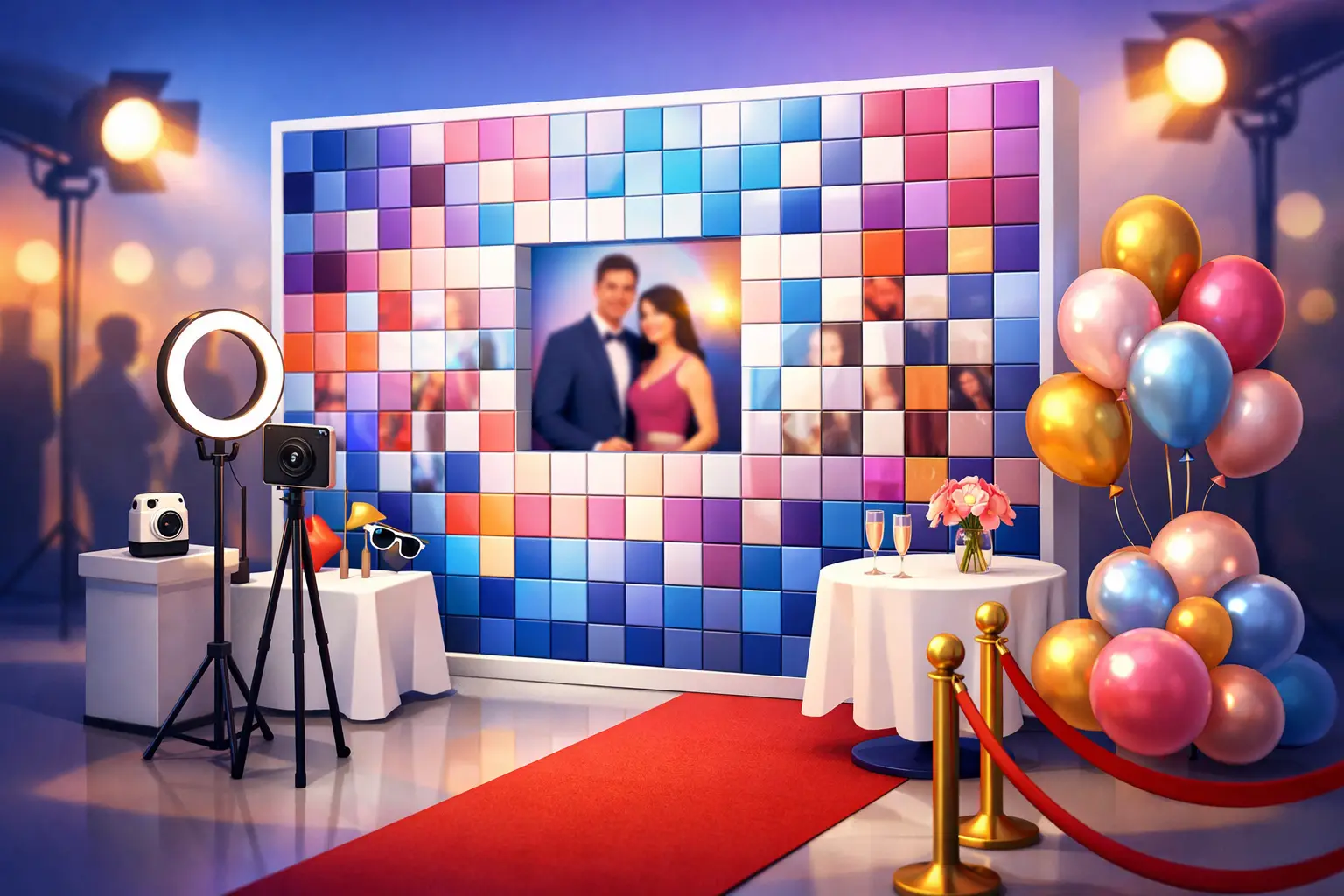
A mosaic wall at events is an interactive installation that transforms individual guest photos into one large image. Guests have their photograph taken, that image is printed or digitally assigned as a small tile, and then placed onto a grid. As more tiles are added, a bigger picture gradually appears.
That larger image might be a couple’s portrait at a wedding, a company logo at a brand launch, a campaign visual at a public activation, or a custom design chosen to suit the occasion. The appeal lies in the reveal. Each guest contributes a small part, but the final result has real impact – both as entertainment during the event and as a finished visual afterwards.
In practical terms, it sits somewhere between a photo experience, an art installation and a statement focal point. For clients who want guest engagement without compromising on aesthetics, that balance matters.
How a mosaic wall works during an event
The guest journey is simple, which is part of why it works so well. A guest steps up for a photograph, usually at a nearby photo booth or capture point. Their image is then processed into a small tile that corresponds to a numbered place on the mosaic wall. They take that tile and place it in the matching position.
At first, the wall looks abstract. A few tiles in, guests can see texture and colour building. As the event progresses, the full image becomes clearer and the installation starts to draw people back in. It creates that useful second moment of attention – guests do not just use it once, they return to see how it is developing.
That evolving nature is what gives the mosaic wall its atmosphere. It is not static decor. It changes hour by hour, and guests feel part of that transformation.
The visual payoff
The strongest mosaic walls are chosen with the room in mind. In a wedding setting, the final image often feels emotional – a portrait, a monogram or a meaningful visual rendered through hundreds of guest interactions. At a corporate event, the payoff is often more strategic. The finished artwork can reinforce branding, product messaging or campaign identity without feeling overly forced.
Because the image is revealed gradually, there is a natural sense of anticipation. That makes it especially effective at longer receptions, gala dinners, networking events and launches where you want energy to build across the evening rather than peak too early.
Why mosaic walls have become so popular
Part of the appeal is that they answer a common event brief very elegantly. Clients want something interactive, visually polished and memorable. They also want an experience that photographs well, feels current and gives guests a reason to engage beyond standing at the bar.
A mosaic wall does all of that, but in a refined way. It is participatory without being chaotic. It creates content without demanding too much from guests. And crucially, it can be styled to suit design-led events where the entertainment needs to feel every bit as considered as the florals, tablescape or staging.
There is also a more emotional reason it lands so well. People like to contribute to something larger than themselves. At weddings, that contribution feels personal and celebratory. At corporate events, it can create a genuine sense of collective participation, which is especially useful when you are trying to bring teams, clients or audiences together around a shared moment.
What is a mosaic wall at events used for?
The format is versatile, but it is not one-size-fits-all. Its value changes depending on the event.
For luxury weddings, it works beautifully as a guest experience with meaning. Rather than simply collecting photographs, you are building a keepsake from the people in the room. The final piece reflects the celebration itself – every guest literally forms part of the image.
For corporate events, the mosaic wall is often used as an engagement tool. It can draw footfall to a stand, create a branded photo moment, encourage dwell time and produce a visual centrepiece that evolves in front of attendees. When done well, it feels more elevated than standard branded entertainment because the end result has scale and presence.
For private celebrations, from milestone birthdays to anniversary parties, it adds theatre. Guests get the instant satisfaction of taking part, while the host gets a striking installation that changes throughout the event and leaves a lasting impression.
What makes a mosaic wall feel premium rather than gimmicky?
This is where execution matters. The concept is inherently engaging, but the finish determines whether it feels sophisticated or simply noisy.
Design is the first factor. The wall should sit comfortably within the wider look of the event, not compete with it. The imagery needs to be chosen carefully, the print quality should be crisp, and the surrounding setup should feel intentional. A beautifully designed capture area, a well-proportioned wall and a considered colour story make all the difference.
The guest experience is equally important. If the process is confusing, guests lose interest. If it is smooth, quick and well hosted, participation stays high. Good pacing matters too. At some events, you want a gentle build across the whole evening. At others, you may want a more visible reveal before speeches, a product moment or the close of the night.
Then there is placement. A mosaic wall needs enough visibility to attract attention, but enough space that guests can engage with it comfortably. In premium venues, that usually means integrating it into the flow of the room rather than tucking it into a forgotten corner.
Is a mosaic wall right for every event?
Not always, and that is worth saying clearly.
A mosaic wall works best when guest interaction is part of the brief. If your event is highly formal with very limited movement, or the schedule leaves little room for guests to explore, another installation may suit the format better. Likewise, if your priority is high-volume fast capture rather than a cumulative visual outcome, a different photo activation may be more effective.
It also depends on what kind of impression you want to create. If you want a single hero moment that evolves over time, a mosaic wall is compelling. If you need instant spectacle from the first minute guests arrive, it is often strongest when paired with an already striking environment.
For many weddings and brand events, though, that gradual reveal is exactly the point. It gives the experience longevity. Instead of peaking in the first fifteen minutes, it keeps giving guests a reason to look up, take notice and come back.
The value goes beyond the event itself
One of the quieter strengths of a mosaic wall is that it leaves you with something tangible. The final artwork is not just evidence that guests had their photo taken. It is a record of collective participation, presented as a finished piece.
For couples, that can feel deeply personal. For brands, it can extend the life of the event through photography, social content and post-event storytelling. It also works especially well for organisers who care about guest experience and visual legacy in equal measure.
That is why a mosaic wall tends to resonate with clients planning design-conscious events. It does more than fill a corner or entertain a queue. It creates a focal point with movement, meaning and a clear visual payoff.
At MooMuu Experiential, that is exactly the appeal of a live Mosaic Wall. When thoughtfully curated and beautifully delivered, it turns guest participation into something far more memorable than a photo – a shared artwork that earns its place in the room.
If you are considering one for your event, the best question is not simply what it does, but what you want your guests to feel when they see the final image come together.